The lights flicker, the router clicks off, and suddenly your cozy evening becomes an awkward scramble for flashlights and phone batteries. People look for the best battery backup for home power outage because blackouts are an equal-opportunity nuisance: they interrupt work, spoil food, and can cut power to life-supporting devices. Buyers often mix up UPS units that are meant to protect electronics and shut down a PC gracefully with larger portable power stations that can run fridges and CPAP machines for hours. Picking the wrong category is the single most common mistake; it leaves you with either too little runtime or a bulky unit you never use.
What matters most depends on how you plan to use the battery backup. If your priority is keeping a home office running through intermittent outages, look for a UPS with fast switchover, pure or simulated sine wave output, and enough wattage to handle your equipment. If you need extended runtime for refrigerators and lights, portable power stations with LiFePO4 batteries and high wattage output are the better fit. Other practical details matter too: recharging speed, number and type of outlets, mobility, and whether the battery is user-replaceable. Different buyers have different priorities, and the ideal unit for a small apartment will feel wrong in a suburban home with a chest freezer.
The picks below balance those needs. My top overall recommendation for most households that want fast recharging, solid capacity, and reliable UPS behavior is the Anker SOLIX C1000 Gen 2. It combines real-world wattage, a durable LiFePO4 pack, and quick recharge times that make it useful both during outages and for everyday preparedness.
If you are short on time, the comparison table below gives a quick overview of the top options and links to the detailed reviews that follow.
Best Battery Backup For Home Power Outage Comparison Table
| Product | Best For | Main Strength | Key Specs |
|---|---|---|---|
| Anker SOLIX C1000 Gen 2 | Best Overall | Fast recharge, balanced capacity | 1,024Wh; 2,000W continuous; 10 ms UPS |
| BLUETTI Elite 300 | Best Premium | Large 3kWh capacity in compact form | 3,014Wh; 2,400W; 10 ms UPS |
| APC BE600M1 | Best Desktop/Value | Affordable, replaceable battery | 600VA/330W; 7 outlets; USB port |
| Anker SOLIX C2000 Gen 2 | Best For Extended Runtime | Big capacity and high power output | 2,048Wh; 2,400W continuous |
| CyberPower CP1500PFCLCD | Best For Home Office | PFC-sine wave for sensitive gear | 1500VA/1000W; 12 outlets; LCD |
| APC Back-UPS Pro 1500 | Best For Heavy Loads | High VA for longer runtimes | 1500VA/900W; AVR; 10 outlets |
| Jackery Explorer 300 | Best Portable Small Capacity | Light and fast recharge for essentials | 293Wh; 300W AC; 60W PD |
| Amazon Basics 600VA | Best Budget UPS | Simple protection for networks | 600VA/360W; 8 outlets |
| MARBERO M82 Portable Power Station | Best Small Emergency Pack | Tiny size with multi-ports and light | 88Wh; 120W peak; LED light |
If you want a closer look at what each pick does well and who it suits, read the detailed reviews below — each section includes real-world notes to help match a unit to your outage plan.
1. Best Overall: Anker SOLIX C1000 Gen 2 Portable Power Station
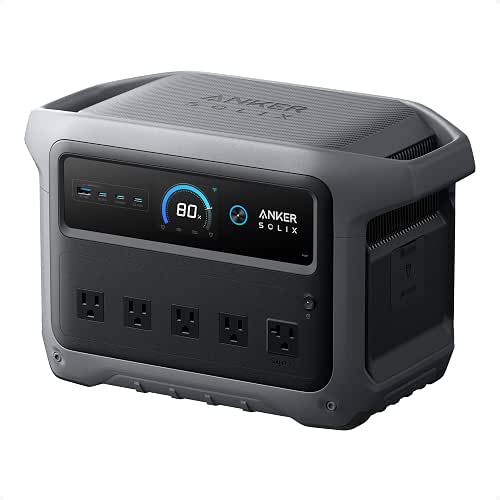
One reason this option stands out is how it blends a true UPS behavior with portable power station flexibility. The SOLIX C1000 Gen 2 gives you roughly 1,024Wh of LiFePO4 capacity with a 2,000W continuous inverter and peak bursts to 3,000W. That combination means you can keep a mini-fridge, router, laptop, and lights running through multi-hour outages, and still have enough headroom to handle brief motor starts on small appliances. The 10 ms UPS switchover is fast enough for most consumer electronics, including CPAP machines and desktop routers, so you avoid the painful reboots and lost work that come with sudden drops.
In real life that translates to practical flexibility. I found it handy during a sudden storm when neighbors lost power for hours: I powered a router, a laptop for remote work, and low-power lighting in the kitchen while the oven waited. The unit’s HyperFlash recharging and app-driven settings also shine when you need to top up quickly between outages. It’s also compact enough to move between rooms or into a vehicle for short trips, so it serves double duty for weekend camping or emergency relocation.
Pros
- High continuous output suitable for a wide range of appliances.
- Fast recharging when you have AC or solar available.
- Durable LiFePO4 cells give long cycle life and stability.
- 10 ms UPS support keeps sensitive devices running smoothly.
- Portable design makes storage and repositioning straightforward.
Cons
- 1,024Wh is excellent for short to medium outages but may be tight for multi-day needs without solar or recharging.
- Higher upfront cost than basic UPS units for desktop electronics.
This is the pick for households who want a versatile all-rounder. It works as a primary outage solution for small-to-medium needs and as a high-quality emergency power station for remote trips. If you need multi-day fridge-level backup without recharging, pair it with additional solar input or consider a larger-capacity unit. The SOLIX C1000 Gen 2 is the closest thing to a daily-use, always-ready backup that doesn’t become clutter in your garage.
To buy this product, click here.
2. Best Premium: BLUETTI Elite 300 Portable Power Station

For buyers who prioritize runtime and capacity without hauling a garage full of batteries, the Elite 300 answers with a substantial 3,014Wh capacity crammed into a compact footprint. The headline here is the usable energy. In practice that means you can run a full-size fridge, multiple lights, a router, and charge devices through a long storm-induced outage. The Elite 300’s 2,400W continuous inverter and 4,800W surge capability also handle tougher loads at startup, so kettles and compressors get the initial jolt they need.
Two scenarios highlight why you might go premium. First, a family that depends on a chest freezer and needs extended food safety during a multi-day blackout. Second, someone with essential home medical equipment who wants confidence that backup won’t drop under load. The Elite 300’s 10 ms UPS capability and app control add a layer of convenience for monitoring and managing consumption when every watt counts.
Pros
- Massive 3kWh capacity in a relatively compact package.
- High surge and continuous output for start-up loads.
- 10 ms UPS switching for critical devices.
- App control and versatile recharge options.
- Good fit for multi-day outages or larger households.
Cons
- Premium size and capacity mean higher cost and greater weight than basic UPS units.
- May be overkill for users who only need short-term router/PC protection.
Choose the Elite 300 if you want serious home backup without wiring in a permanent generator. It’s best for households that value runtime and the ability to run larger appliances. Skip this one if your needs are limited to protecting a desktop PC and router; smaller, cheaper UPS units will handle that for a fraction of the cost.
To buy this product, click here.
3. Best Desktop/Value: APC BE600M1 UPS Battery Backup

If your priority is keeping a home office, router, and a phone charged through short outages, this APC model is a dependable and unflashy pick. The BE600M1 provides about 600VA/330W with five battery-backed outlets plus two surge-only outlets. It’s a familiar sight on many desks because it covers the basics: safe shutdown time for a PC, uninterrupted internet for video calls, and a USB port for quick phone top-ups when the lights go out. The replaceable internal battery is a practical detail; swapping an aging battery takes minutes and avoids buying a new unit.
In everyday terms that means you can ride out short outages or buy yourself enough time to finish a meeting and shut systems down properly during a longer blackout. It’s small, quiet, and includes APC’s equipment protection plan and warranty which is reassuring for sensitive home electronics. The runtime is modest — roughly 23 minutes at a light load — but that’s precisely what this category is meant for: bridging interruptions and preventing data loss.
Pros
- Reliable performance for desktop setups and routers.
- User-replaceable battery avoids throwing out the entire unit.
- USB charging keeps phones alive during outages.
- Trusted brand with warranty and connected equipment protection.
- Compact footprint fits under or behind a desk.
Cons
- Limited runtime for heavier loads; not meant for refrigerators or long outages.
- No pure sine wave output, which can matter for certain sensitive PSUs.
This APC is the sensible option for anyone who wants straightforward protection without learning a new power vocabulary. Buy it if you need guaranteed uptime for work-from-home gear and internet hardware. Look elsewhere when you need extended runtime or to power major appliances.
To buy this product, click here.
4. Best For Extended Runtime: Anker SOLIX C2000 Gen 2 Portable Power Station
If your outage plan includes keeping a fridge, freezer, and a few critical circuits alive for many hours, the C2000 Gen 2 is purpose-built for that. With roughly 2,048Wh of LiFePO4 capacity and a 2,400W continuous inverter, this unit runs mid-sized appliances at a more homeowner-friendly timescale. It’s engineered to be lighter and more compact than its peers, which matters when you need to move it into the garage or up a flight of stairs during an extended event. The low 9W standby consumption is also a practical detail that adds up over days.
Two everyday moments highlight its value: a multi-hour outage where the fridge needs to stay cold overnight, and a backyard project where you want reliable AC power without hauling a noisy generator. The unit’s fast recharge and multiple ports make it a comfortable hedge against uncertainty; you can deploy it indoors without fumes while still getting a meaningful amount of runtime for important appliances.
Pros
- Large capacity and high continuous output for extended outages.
- Efficient standby draw conserves energy over long runs.
- Fast recharge options reduce downtime between events.
- Portable relative to its capacity considering the output it delivers.
Cons
- Still bulkier and pricier than small desktop UPS units.
- May require additional planning for solar or charging if outages last several days.
Choose the SOLIX C2000 Gen 2 if your priority is multi-hour appliance-level backup without installing permanent infrastructure. It shines in suburban homes and cabins where you need a quiet, safe indoor solution that’s practical and powerful. If you’re only safeguarding a router and laptop, this is more capacity than you require.
To buy this product, click here.
5. Best For Home Office: CyberPower CP1500PFCLCD PFC Sinewave UPS

For people who run a serious home office with active PFC power supplies, NAS boxes, or small servers, this CyberPower model brings a professional touch at a consumer price. The CP1500PFCLCD is a PFC-sine wave UPS rated at 1500VA/1000W with a color LCD for real-time status. The pure or PFC-compatible sine wave output is the technical detail that matters: it prevents issues with certain computer power supplies that can behave poorly on simulated sine wave units. The automatic voltage regulation is another practical benefit because it fixes brownouts without resorting to battery drain.
In practice you get reliable, clean power for sensitive electronics, plus generous outlet layout: six battery-backed outlets and six surge-only outlets. The LCD panel reduces guesswork during an outage, and the included management software lets you automate safe shutdown sequences for servers and workstations. That makes it ideal for someone running a small lab, a content-creation rig, or a remote-work setup where uptime is income.
Pros
- PFC-sine wave output protects modern PSUs and sensitive gear.
- Large wattage rating supports heavier home-office loads.
- Informative LCD and management software simplify monitoring and shutdowns.
- AVR reduces unnecessary battery use during voltage dips.
Cons
- Not portable like power stations; this is a tower UPS meant to sit in one place.
- Battery runtime is still limited compared with multi-kWh power stations.
If your household depends on a small server, a video-editing workstation, or a high-end gaming PC that uses active PFC, this CyberPower unit is an excellent match. It’s aimed at anyone who needs clean, reliable power and better monitoring than a basic UPS. For long-duration fridge power, you’ll want a larger portable battery system instead.
To buy this product, click here.
6. Best For Heavy Loads: APC Back-UPS Pro 1500 (BX1500M)

If you need a UPS that sits between consumer-grade and light commercial capability, the BX1500M is a strong candidate. It’s rated at 1500VA/900W, and offers automatic voltage regulation to keep connected devices stable through brownouts without burning battery cycles. The unit’s design includes both battery-backed and surge-only outlets and extends protection to coax and Ethernet lines — a thoughtful touch for people who run home theater or networking gear with external wiring that’s susceptible to surges.
What makes the BX1500M useful in practice is the balance between runtime and wattage. When the phone rings with a storm warning, you can power a router array, a mid-size PC, and a DVR long enough to safely shut things down, or squeeze through short outages keeping critical systems alive. Energy-conscious buyers also appreciate the ENERGY STAR efficiency and the fact that the battery is user-replaceable for long-term ownership.
Pros
- Higher VA rating gives longer runtimes for heavier loads.
- AVR reduces battery use during voltage fluctuations.
- Coax and Ethernet protection is useful for whole-system safety.
- User-replaceable battery extends the unit’s usable life.
Cons
- Still a short-run UPS rather than a multi-hour power station.
- Bulky compared with smaller desktop options.
This APC is the right choice for home setups with heavier electronics or small media centers that need clean power and surge protection across multiple lines. It’s a practical middle ground for buyers who want more capacity than compact desktop UPS units but don’t need a full portable generator or multi-kWh battery bank.
To buy this product, click here.
7. Best Portable Small Capacity: Jackery Explorer 300 Portable Power Station

If portability and everyday carry matter as much as outage readiness, the Jackery Explorer 300 is a great fit. It weighs just over seven pounds and offers roughly 293Wh with a 300W continuous pure sine wave inverter. The 60W PD USB-C port helps when you need to power a laptop quickly and the unit recharges quickly relative to its size. For quick outages and mobile needs like tailgates or camping, it covers phones, laptops, lights, and small fans with calm efficiency.
Two real-world uses make this practical: charging a laptop and phone during a sudden apartment outage while you work at the kitchen table, and powering a CPAP machine or small fan on a short trip. The Explorer 300’s compatibility with solar panels is also convenient if you plan to top it off off-grid or during extended outages where AC charging isn’t available.
Pros
- Lightweight and easy to carry for mobile uses.
- Good mix of AC and PD USB ports for modern devices.
- Fast recharge relative to its capacity.
- Pure sine wave output keeps sensitive electronics happy.
Cons
- Limited capacity for refrigerator or larger loads.
- Not a replacement for larger home backup systems.
Pick the Jackery Explorer 300 if you want a true grab-and-go power station that doubles as an emergency backup for short interruptions. It is especially useful for small households, renters, and anyone who likes the idea of a lightweight power center for travel and outdoor use.
To buy this product, click here.
8. Best Budget UPS: Amazon Basics UPS Battery Backup 600VA

For buyers who want something economical to protect a router, modem, and a few small devices, the Amazon Basics 600VA UPS is a practical no-frills option. It provides 600VA/360W and four battery-backed outlets. Expected runtime is short at higher loads, but it’s long enough at reduced draw to save sessions, keep internet running, and let you shut down a desktop safely. The compact footprint and low price point make it easy to place under a desk or in a utility closet.
Imagine a late-night software push where you need the internet for another 10 minutes. This unit can buy you that time. Or picture a storm cutting power to your neighborhood for an hour; a router and modem on this UPS would keep work calls alive while you decide if you should relocate to a cafe. It’s an affordable baseline protection strategy: better than nothing and easy to set up.
Pros
- Low cost gives broad accessibility for renters and students.
- Compact and simple to install without extra software.
- Four battery-backed outlets cover core networking gear.
- Software available for basic power management.
Cons
- Short runtime under significant loads; not for appliance use.
- Fewer premium features like pure sine wave output or fast recharge.
This Amazon Basics unit is the right pick when budget matters more than runtime. It’s a sensible step up from having no protection and is ideal for basic home networks and light-office gear. If you need to power a fridge or run long, look at larger portable power stations on this list.
To buy this product, click here.
9. Best Small Emergency Pack: MARBERO M82 Portable Power Station

If space is tight and you want a multi-port emergency unit that doubles as a flashlight, the MARBERO M82 offers surprising utility for its size. At around 88Wh and 120W peak, it won’t tempt you to run a fridge, but it will run lights, charge phones and tablets, and keep a small TV or game console alive for a few hours. The built-in LED light with multiple modes adds real-world value during blackouts when you need targeted illumination and battery savings.
I found this style of pack particularly useful during brief outages and for apartment living: it’s easy to store, quick to grab, and replaces the mess of cables and random power banks lined up on a coffee table. For anyone who needs a compact emergency kit that covers communications and light, this is a solid bargain.
Pros
- Extremely compact and lightweight for easy storage and carry.
- Multiple output ports support simultaneous small-device charging.
- Built-in LED lighting that can double as an emergency flashlight.
- Fast charge to 80% in two hours when you need it ready quickly.
Cons
- Very limited capacity compared with full-size power stations.
- Not suitable for continuous appliance use or extended outages.
This unit is the practical pick for an emergency grab bag, RV travel, or as supplementary backup in a multi-device plan. It’s not a primary home-backup system, but it’s ideal for keeping essential communications and lights on during short interruptions or as an additional layer in a broader outage strategy.
To buy this product, click here.
Best Battery Backup For Home Power Outage FAQ
What’s the difference between a UPS and a portable power station?
UPS units are primarily meant to protect electronics from power interruptions and provide short-term runtime so you can safely shut down devices. They often sit under a desk and focus on clean power and quick switchover. Portable power stations are larger battery banks with inverters designed to run appliances and lights for extended periods. Choose UPS for data protection and short outages; choose a power station for extended, appliance-level backup.
Is pure sine wave output necessary for home devices?
Pure or PFC-compatible sine wave output matters for modern power supplies, certain audio gear, and medical devices. If you run gaming PCs with active PFC or sensitive lab gear, look for sine wave or PFC-sine compatibility. For routers, basic PCs, and lights, simulated sine wave often works fine, but pure sine wave adds a layer of long-term safety.
How do I estimate the runtime I need?
List the devices you want to power, note their wattage, and add them up. Divide the battery capacity (Wh) by total watts to estimate hours of runtime, then reduce that number by 10–20 percent to account for inverter inefficiency and realistic usage. For example, a 1,000Wh battery powering a 200W load will last roughly 4–5 hours in typical conditions.
Can I charge a power station with solar during an outage?
Many modern power stations support solar charging and include MPPT controllers for efficient recharging. Solar is a practical way to extend uptime during multi-day outages, but you’ll need panels sized to the station’s input capacity and sufficient sun. Fast recharging options like high-watt AC input or alternator charging are useful when solar isn’t available.
Are LiFePO4 batteries better than lead-acid?
LiFePO4 cells generally offer longer cycle life, better thermal stability, higher usable energy density, and lighter weight compared with lead-acid. They cost more upfront but often have lower total cost of ownership. For frequent or long-term backup use, LiFePO4 is usually the smarter choice.
How often should I test or maintain my backup battery?
Test your backup system at least twice a year by running it under load and checking recharge behavior. For UPS units, replace internal batteries according to the manufacturer’s guidance, typically every 3–5 years for lead-acid. LiFePO4 units will last significantly longer but still benefit from periodic checks and firmware updates where applicable.
Can I run a refrigerator with a portable power station?
Yes, but calculate both starting surge and continuous draw. Refrigerators require a high surge to start the compressor, so pick a station with sufficient peak wattage and continuous output. Also consider capacity: running a fridge for many hours requires a multi-kWh pack or solar recharging strategy.
Is it safe to run a power station indoors?
Most household-rated portable power stations with sealed LiFePO4 or lithium-ion cells are safe for indoor use because they do not emit carbon monoxide like gas generators. Still, follow manufacturer ventilation and temperature guidelines, and avoid enclosing the unit tightly while it’s charging or discharging under heavy load.
Final Verdict
Choosing the best battery backup for home power outage depends on what you must keep running and how long. For most households wanting a versatile, reliable solution that works both in the home and on the road, the Anker SOLIX C1000 Gen 2 hits the sweet spot: solid capacity, high continuous output, rapid recharge, and UPS behavior that prevents interruptions for sensitive gear. If your needs lean toward extended runtimes or running large appliances, step up to the BLUETTI Elite 300 or the Anker SOLIX C2000 Gen 2; both provide the extra kilowatt-hours and surge headroom needed for refrigerators and multi-day scenarios.
For budget-focused buyers or renters who simply want to protect a router, desktop, and phone during short outages, the APC BE600M1 and Amazon Basics 600VA provide reliable, affordable protection that keeps essentials online and data intact. Finally, small portable units like the Jackery Explorer 300 and the MARBERO M82 are perfect as secondary devices in an outage kit or for grab-and-go emergency power.