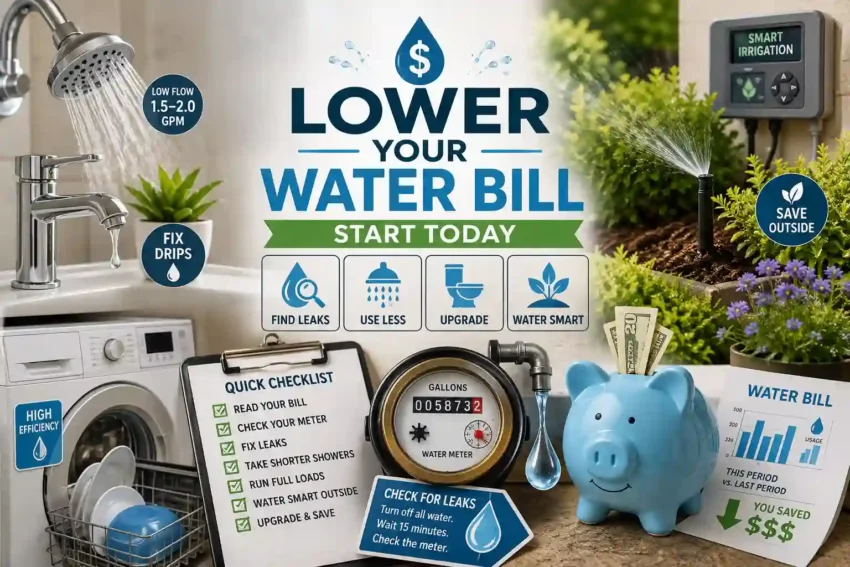
If you opened a water bill that felt shockingly high, this practical guide explains how to lower water bill with clear, realistic steps you can start today. The suggestions here focus on what actually moves the needle for homeowners and renters: quick fixes that pay back fast, moderate upgrades with reasonable returns, and the larger investments worth considering if you want long-term savings. Wherever possible the guidance includes simple tests, cost ranges, and examples so you can judge what will matter in your situation.
Start with the basics: read your bill and your meter
Before buying gadgets or swapping fixtures, understand your bill. Many people try fixes without knowing what drives their water use.
How to read your water bill
- Look for the billing period and compare usage to the prior period and the same period last year. Seasonal changes in irrigation often explain big jumps.
- Check the units used. Many utilities bill in 1,000 gallons or cubic feet. One cubic foot equals about 7.48 gallons.
- Note the rate structure. Is there a flat rate, a tiered system that charges more above a threshold, or separate sewer charges tied to water use? Tiered rates make conservation more valuable.
- Scan for unusual charges like late fees, meter tampering, or repairs that could inflate a single bill.
Verify actual flow with your water meter
A quick meter check can reveal hidden leaks or running fixtures.
- Turn off all water inside and outside the house.
- Record the meter reading or note the small leak indicator dial. Wait 15 minutes and check again. Any movement usually means a leak.
- Do a toilet test: stop water, then do one toilet flush and watch the meter. If the meter keeps moving after the flush, the toilet may be refilling continuously.
This simple check costs nothing and often finds the culprit. Leaks are a common surprise reason for high bills.
Low-cost fixes you can do today
These actions require little or no money and typically produce immediate savings.
Fix leaks
Leaking toilets and dripping faucets are the low-hanging fruit.
- Toilet leak test: drop a few drops of food coloring into the tank. Wait 10 to 30 minutes without flushing. If color appears in the bowl, the flapper or flush valve seal is leaking. Replacing a flapper costs under $10 and often takes 5 minutes.
- Faucets: a slow drip may look small but can add up. Replace worn washers or cartridges for $5 to $20.
- Outdoor spigots and irrigation: tighten hose connections and inspect valves and sprinkler heads. A broken sprinkler head can waste hundreds of gallons per day.
Reduce shower time and flow
Showers are one of the largest indoor uses. Small behavior changes make a big difference.
- Cut shower time by 2 to 3 minutes. A five-minute reduction for a household of four can save thousands of gallons per year.
- Install a low-flow showerhead. Modern models deliver good pressure at 1.5 to 2.0 gallons per minute (gpm). Many are under $30 and self-installable.
- Use a bucket during warm-up to capture cold water and reuse it for plants or flushing, where local rules allow.
Run full loads only
Dishwashers and washing machines use water efficiently when full.
- Delay washing until you have full loads, and use load-size settings when available.
- Newer ENERGY STAR dishwashers are often more water-efficient than hand-washing, especially when fully loaded with an efficient cycle.
Short-term behavior checklist
- Turn off the tap while brushing teeth and shaving.
- Use a broom to clean driveways and patios rather than hosing.
- Collect rinse water from fruits and vegetables for plants.
Know where your water goes: typical household water use
Understanding the breakdown helps prioritize actions. Percentages vary by household, but this table gives a practical snapshot for a typical U.S. home.
| Use | Typical share of indoor water | Typical flow or amount |
|---|---|---|
| Toilets | 20 to 30% | 1.28 to 6 gallons per flush |
| Showers | 20 to 30% | 2 to 4 gallons per minute |
| Faucets | 15 to 20% | 0.5 to 2 gallons per minute |
| Washing machine | 15 to 20% | 15 to 40 gallons per load |
| Leaks | 5 to 15% | Varies |
| Dishwasher | 1 to 4% | 4 to 6 gallons per cycle for efficient models |
These figures are illustrative. Your priorities should focus on toilets, showers, and leaks first.
Moderate investments with solid payback
Spending a bit usually speeds savings. Here are upgrades that typically justify their cost within a few years or less.
Replace older toilets
Older toilets from before the 1990s often use 3.5 to 6 gallons per flush. Modern efficient models use 1.28 gpf or even dual-flush options.
Example calculation
- Old toilet: 3.5 gpf, 5 flushes per person per day, household of 4 = 70 gallons/day, 25,550 gallons/year.
- New 1.28 gpf: same behavior = 25.6 gallons/day, 9,344 gallons/year.
- Annual water savings = 16,206 gallons. At $4 per 1,000 gallons, savings ~ $64 per year on water plus reduced sewer charges. If toilet costs $150 installed self or $300 pro, simple payback is a few years.
Actual savings vary by flush frequency and local water prices. Dual-flush and high-efficiency models are good options where initial cost is higher but water is expensive.
Upgrade to a high-efficiency washer
Front-load or newer high-efficiency top-load machines use 15 to 25 gallons per load, compared with older top-loaders that can use 30 to 45 gallons. If you do multiple loads a week, a new washer pays back in water and energy savings, since less hot water is used.
Consider load size and detergents that allow full but not over-wet loads for best efficiency.
Install a smart irrigation controller and drip lines
Outdoor watering is often the largest single use in many homes, especially in hot months.
- Smart controllers that use local weather or soil moisture sensors can cut outdoor use by 20 to 50 percent versus fixed schedules.
- Switch from spray heads to low-volume drip irrigation for flower beds and shrubs. Drip applies water more directly and reduces evaporation.
- Mulch heavily around plants to retain moisture and reduce watering frequency.
Smart controllers cost from $100 to $300, with many utilities offering rebates. Drip kits are inexpensive and simple to install for small beds.
Major upgrades and longer-term options
These moves need a bigger budget or professional help but deliver lasting savings and convenience.
Replumb or add pressure regulators
Very high water pressure wastes water and stresses fixtures. Measure pressure with a gauge at an outdoor spigot. Normal household pressure is 40 to 60 psi. If pressure is above 80 psi, install a pressure regulator to cut waste and extend fixture life.
Consider gray water and rain harvest where legal
Reusing laundry rinse water for irrigation or collecting rain for outdoor use can cut municipal water use significantly. Legal and plumbing rules vary by location, so check local codes and utilities for approved systems and rebates.
Systems range from simple rain barrels to professionally plumbed gray water setups. Rain barrels are cheap and quick; designed gray water systems require a plumber and may need permits.
Replace turf with drought-tolerant landscaping
Lawns are water-intensive. Converting part or all of a lawn to native plants, gravel, or low-water groundcover reduces watering needs and maintenance. Costs vary widely, but incremental changes—like replacing high-water areas first—keep upfront cost manageable.
Appliance and fixture comparison table
This table gives approximate water use so you can compare options. Numbers are typical ranges; local models vary.
| Item | Old model water use | Efficient model water use | Approximate water saved per use |
|---|---|---|---|
| Toilet | 3.5 to 6 gpf | 1.28 to 1.6 gpf | 2.2 to 4.4 gallons per flush |
| Showerhead | 3.5 to 5 gpm | 1.5 to 2.0 gpm | 1.5 to 3.5 gpm |
| Washing machine (top-load older) | 30 to 45 gallons per load | 12 to 25 gallons per load | 8 to 33 gallons per load |
| Dishwasher | 10 to 15 gallons per cycle | 3 to 6 gallons per cycle | 4 to 12 gallons per cycle |
| Faucet | 2 to 2.5 gpm | 0.5 to 1.5 gpm | 0.5 to 2 gpm |
How water prices affect your ROI
Local water and sewer charges determine how fast investments pay back. Many utilities charge more for wastewater based on metered water, so reducing water also reduces sewer bills. Here’s a simple way to estimate savings.
- Find your water price per 1,000 gallons and sewer price per 1,000 gallons on the bill or utility website.
- Add them to get combined cost per 1,000 gallons.
- Multiply expected annual gallons saved by that combined rate and divide by 1,000 for annual dollar savings.
Example: If combined rate is $6 per 1,000 gallons and you save 10,000 gallons annually, annual savings are about $60. This shows why behavioral changes and big reductions in outdoor irrigation are often the best first steps in areas with lower water prices.
How leaks add up: examples and math
Leaks can be surprisingly costly. A small constant flow becomes large over time.
- A faucet dripping once per second wastes about 3,000 gallons per year.
- A toilet that runs continuously can waste 200 to 400 gallons per day, depending on the leak. That adds up to 6,000 to 12,000 gallons per month.
- An irrigation leak from a broken valve or head could easily waste 1,000 gallons per day if unnoticed.
Those volumes quickly translate to tens or hundreds of dollars depending on local rates. Fixing small leaks is often the cheapest way to lower the bill.
Outdoor water use: practical saving techniques
Outdoor savings usually have the biggest payoff in many climates.
Water at the right time
Water early in the morning, before sunrise if possible. This reduces evaporation and ensures water reaches plant roots. Avoid watering in the heat of the day or in windy conditions.
Match water to plant needs
- Group plants by water need so you do not overwater drought-tolerant species.
- Use drip irrigation for plants and shrubs and microsprays for small beds.
- Install soil moisture sensors so systems run only when plants need water.
Lawn alternatives and maintenance
- Reduce lawn area gradually, replacing with native or drought-resistant groundcover.
- Set mower blades to a higher height so grass develops deeper roots and needs less water.
- Repair leaks in irrigation valves and replace inefficient spray heads.
Smart devices and monitoring
Technology can help find leaks early and automate efficient watering.
Leak detectors
Battery-powered leak sensors are inexpensive and can alert you to puddles or continuous flow under sinks and near appliances. More advanced systems can shut off the main when a large leak is detected. Consider them for vacation homes or if you travel frequently.
Smart water meters and apps
Some utilities offer usage portals that show near real-time data. Third-party devices can also monitor flow at the main and show patterns that reveal leaks or unusual usage. These tools are especially useful for identifying nighttime leaks like running toilets.
Common myths and mistakes
Separating myth from fact helps you prioritize.
Myth: Dishwashers always use more water than hand-washing
Reality: Modern dishwashers, especially ENERGY STAR models, often use less water than hand-washing when run full and on an eco cycle. Hand-washing can use much more if you let the faucet run continuously.
Myth: Low-flow means poor pressure and a miserable shower
Reality: Many newer low-flow showerheads are engineered to provide strong spray patterns even at 1.5 to 2.0 gpm. Try reputable brands and models with good reviews rather than the cheapest options.
Mistake: Ignoring sewer charges
Some people focus only on water rates. In many systems, sewer charges make up a large portion of the bill and are tied to water use. Reducing indoor water is the best way to lower combined charges.
Mistake: Overwatering to compensate for perceived dry patches
Frequent shallow watering leads to shallow roots and more water needed overall. Water deeply and less often so roots grow deeper and plants become drought resilient.
How renters can lower a water bill
Renters have fewer options but still can save meaningfully.
- Report leaks promptly to your landlord. Providing a simple meter test result can speed repairs.
- Use water-saving behaviors like shorter showers and full loads. Small changes cost nothing.
- Install removable aerators and low-flow showerheads that screw on and off with no permanent changes. Keep original fixtures to reinstall when you move if required.
- If you pay for water directly, ask the landlord about landlord-installed upgrades; they may share costs for improvements that raise property value.
Incentives, rebates, and utility programs
Many utilities and local governments offer rebates for efficient toilets, washers, smart controllers, and turf replacement. Check your utility website for programs. Rebates often cut payback time and make higher-cost upgrades more attractive.
Utilities may also offer free or discounted leak detection services, water audits, and low-flow kits. These are worth checking before buying equipment.
Prioritized step-by-step plan
Use this practical sequence to lower your bill efficiently.
- Read your bill and check your meter to verify unusual usage.
- Fix obvious leaks: running toilets, dripping faucets, and hose leaks.
- Cut shower time and install a low-flow showerhead if showers are long.
- Run only full dishwasher and laundry loads; use efficient cycles and cold water when possible.
- Adjust outdoor watering schedule and fix irrigation leaks; install a smart controller if irrigation is a major use.
- Consider replacing high-use fixtures like toilets and washers next, using local rebates to reduce cost.
- If you still have high use, invest in monitoring tools or a professional water audit to find hidden problems.
Estimate your savings: sample scenarios
Here are realistic examples to help you estimate potential savings based on common changes. Replace numbers with your local rates for more accurate results.
Scenario A: Fixing a running toilet
- Leak wastes 200 gallons per day = 73,000 gallons per year.
- At $4 per 1,000 gallons, cost = $292 per year. At $8 per 1,000 gallons with sewer, cost = $584 per year.
- Replacing a $10 flapper or paying a plumber for a small fix quickly pays back.
Scenario B: Switching to a high-efficiency washer
- Old washer uses 35 gallons/load, new uses 18 gallons/load, savings 17 gallons per load.
- If you do 5 loads per week, annual savings = 4,420 gallons.
- At $6 per 1,000 gallons, annual savings ~ $26.50. Add energy savings from reduced hot water to improve return.
Scenario C: Cutting outdoor use by 30%
- Outdoor use 30,000 gallons per season reduced by 30% = 9,000 gallons saved.
- At $6 per 1,000 gallons, seasonal savings ~ $54. Pair this with reduced sewer charges for more impact.
These examples show that some indoor fixes like toilets and leaks often yield larger dollar savings per dollar spent than appliance replacements in areas with low water prices. Outdoor reductions matter most in climates where irrigation dominates usage.
Legal and safety notes for reuse and gray water
Reusing gray water can save water but local codes differ. Common rules include:
- Gray water may not be allowed to contact edible plants directly in some jurisdictions.
- Systems may need permits and must be installed to avoid odors, standing water, and contamination.
- Simple rain barrels are usually allowed, but check local bylaws regarding overflow and mosquito control.
Always check local plumbing codes and health department rules before installing any system that repurposes household wastewater.
FAQ
How much can I reasonably expect to lower my water bill?
Typical, cost-effective reductions range from 10 to 40 percent depending on current behavior, leaks, and the mix of indoor and outdoor use. Homes with significant leaks or inefficient outdoor watering often see the biggest improvements quickly.
Should I replace my showerhead and faucets right away?
Start with low-cost showerhead and aerator replacements if showers or faucets are older. These often cost under $30 and improve water use without sacrificing comfort. Prioritize based on your bill and habits.
Will a dishwasher save water compared with hand-washing?
Yes, most modern dishwashers are more water-efficient than hand-washing when run full on an eco cycle. Hand-washing with a continually running faucet uses far more water.
Are smart irrigation controllers worth the cost?
In landscapes that require regular watering, smart controllers can cut water use by 20 to 50 percent. Rebates often lower upfront cost. For small yards or very drought-tolerant landscaping, the value is smaller.
How do I know if I have a hidden leak?
Do the meter test: shut off all water, check the meter, then wait 15 minutes. If the meter moves, investigate. Toilets are the most common hidden source. If the monthly bill spikes without extra visible use, suspect a leak.
Can I lower my bill by changing my water heater settings?
Lowering water heater temperature reduces energy for hot water but does not reduce water volume unless you also change behavior. Insulating hot water pipes and using low-flow fixtures reduce both energy and water waste.
Final checklist before you finish
- Read your bill and know your water and sewer rates.
- Do a quick meter leak test and fix obvious leaks.
- Install low-cost fixtures like aerators and efficient showerheads.
- Run full appliance loads and reduce shower times.
- Audit outdoor watering and install smart controllers or drip irrigation where it makes sense.
- Look for rebates and utility programs before buying.
Conclusion
Learning how to lower water bill starts with information and small, targeted actions. Fix leaks, change a few habits, and make selective upgrades based on where your water is used most. Toilets, showers, and outdoor irrigation typically offer the biggest savings. Use your meter and bill to track progress and lean on rebates and smart devices to speed payback. With a few practical steps you can reduce water use, save money, and avoid surprise high bills without major disruption.