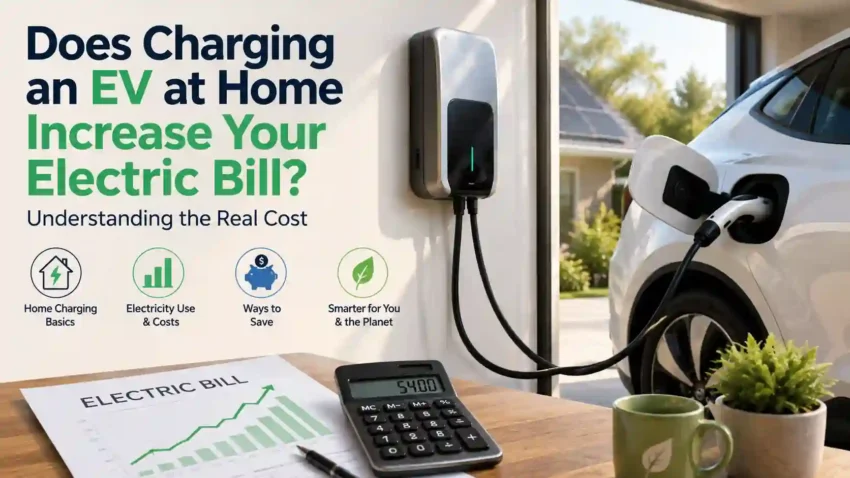
Yes, charging an electric vehicle at home will increase your electricity bill because the energy stored in the vehicle’s battery has to come from somewhere. The more useful question is how much the bill will increase—and whether that increase is large compared with what you would otherwise spend on gasoline.
For many households, an EV becomes one of the larger individual electrical loads in the home. That does not automatically make home charging expensive. Your actual cost depends on how many miles you drive, how efficiently your vehicle uses electricity, your local electricity rate, charging losses, and whether your utility offers cheaper off-peak charging.
The good news is that you do not need a complicated calculator to estimate the impact. With your monthly mileage, your vehicle’s energy-consumption figure, and the price you pay per kilowatt-hour, you can get a useful estimate in a few minutes.
Quick Answer: How Much Does EV Charging Add to an Electric Bill?
A typical household may use a few hundred additional kilowatt-hours of electricity each month to charge an EV, although the number can be much lower or higher depending on driving habits and vehicle efficiency.
As a simple example, suppose an EV uses 30 kWh of electricity per 100 miles and you drive 1,000 miles per month:
1,000 miles ÷ 100 × 30 kWh = 300 kWh
If electricity costs 18 cents per kWh:
300 kWh × $0.18 = $54 per month
The actual amount drawn from the wall will normally be somewhat higher than the energy ultimately stored and used by the vehicle because charging itself is not perfectly efficient. Climate control, battery temperature management, cold weather, and other factors can also affect real-world electricity consumption.
That means the example should be treated as a starting point rather than a guaranteed monthly bill.
Why an EV Can Become a Noticeable Household Electricity Load
Most household devices use relatively little electricity at any one time or operate for short periods. A phone charger is almost irrelevant to the monthly bill. A television may run for several hours a day but still consume relatively modest amounts of energy.
An electric vehicle is different. Moving a several-thousand-pound vehicle over hundreds or thousands of miles requires substantial energy. If most of that energy is supplied at home, the electricity consumption appears on the household utility bill instead of at a gas station.
This is why a household can buy an EV, change almost nothing else about its daily routine, and still notice an increase in monthly electricity use.
That increase should not necessarily be viewed as an additional transportation expense in isolation. Part of your previous gasoline spending has effectively moved from the gas station to your electric bill.
How to Calculate Your Own Home EV Charging Cost
The most useful estimate uses three numbers:
- Your monthly driving distance
- Your EV’s energy consumption
- Your electricity price per kilowatt-hour
You can then calculate an approximate charging cost with this formula:
Monthly miles × kWh per mile × electricity price per kWh = estimated monthly electricity cost
If your vehicle lists consumption in kWh per 100 miles, divide that number by 100 first.
Example 1: A relatively efficient EV
Suppose you drive 800 miles per month and your EV consumes 26 kWh per 100 miles.
800 ÷ 100 × 26 = 208 kWh
At $0.18 per kWh:
208 × $0.18 = $37.44
Your theoretical vehicle-energy cost would therefore be about $37 per month before allowing for charging losses and other real-world variables.
Example 2: More driving and a less efficient vehicle
Now suppose a larger EV consumes 38 kWh per 100 miles and travels 1,500 miles each month.
1,500 ÷ 100 × 38 = 570 kWh
At the same $0.18 electricity price:
570 × $0.18 = $102.60
Both households own electric vehicles, but their charging costs are dramatically different. That is why a single statement such as “an EV costs $50 a month to charge” is not particularly useful without knowing the assumptions behind it.
Electricity Rates Matter More Than Many Drivers Expect
The price of electricity varies substantially by location, utility, season, and rate plan. According to the U.S. Energy Information Administration, the average residential electricity price in the United States was 18.16 cents per kWh for January through June 2026. The national average for June 2026 alone was 18.34 cents per kWh.
Those national figures are useful for examples, but they should not replace the rate shown on your own electricity bill. Some households pay considerably less, while households in certain high-cost electricity markets can pay much more.
You can check current national and state electricity-price data through the U.S. Energy Information Administration.
For estimating your own EV cost, look at your bill and determine what you actually pay per kWh. Be careful with utility bills that separate generation, delivery, taxes, or other charges. The headline energy rate may not represent the complete variable cost of consuming an additional kilowatt-hour.
Does Level 1 or Level 2 Charging Change Your Electric Bill?
Level 1 and Level 2 charging primarily describe how quickly electricity can be delivered to the vehicle. They do not create fundamentally different units of electricity: one kilowatt-hour is still one kilowatt-hour.
However, the charging method can influence real-world efficiency and convenience.
Level 1 charging typically uses a standard household outlet and delivers energy relatively slowly. This can work well for drivers with modest daily mileage, especially when the car remains parked overnight for long periods.
Level 2 charging uses a higher-power circuit and can restore driving range much more quickly. For households that drive farther, have multiple EVs, or need predictable overnight charging, it is often more practical.
A faster charger does not mean that your car suddenly requires twice as much energy to travel the same distance. A battery that needs roughly 50 kWh of usable energy still needs roughly that amount whether it is replenished slowly or quickly. The differences are mainly charging time, equipment, electrical requirements, and some efficiency-related losses.
If you are deciding what type of equipment makes sense for a garage or driveway, this comparison of home EV chargers covers the main charging options and features to consider.
Why the Energy From the Wall Is Higher Than the Energy Used for Driving
One common mistake is to multiply the vehicle’s rated electricity consumption by local electricity prices and assume the result will exactly match the utility bill.
Real charging has losses.
Some electrical energy is lost while AC electricity from the home is converted and transferred into the battery. Energy may also be used by pumps, electronics, thermal-management systems, and other components while the vehicle is plugged in.
Environmental conditions matter too. A battery that has to be heated during a cold winter or cooled during very hot weather can require additional electricity beyond the energy that eventually moves the vehicle down the road.
For this reason, vehicle efficiency figures are best treated as a useful baseline. If you want to know exactly how much home charging is costing you, measuring electricity delivered by the charger—or reviewing charging data provided by the vehicle or EV charging equipment—can be more informative than relying only on the vehicle’s advertised efficiency.
How Much Would 1,000 Miles of Home Charging Cost?
The table below illustrates how electricity rate and vehicle efficiency can change the result. These figures represent simple energy calculations before additional real-world charging losses.
| Vehicle Consumption | Electricity Rate | Energy for 1,000 Miles | Estimated Cost |
|---|---|---|---|
| 25 kWh/100 miles | $0.12/kWh | 250 kWh | $30.00 |
| 25 kWh/100 miles | $0.18/kWh | 250 kWh | $45.00 |
| 30 kWh/100 miles | $0.18/kWh | 300 kWh | $54.00 |
| 35 kWh/100 miles | $0.18/kWh | 350 kWh | $63.00 |
| 40 kWh/100 miles | $0.18/kWh | 400 kWh | $72.00 |
| 40 kWh/100 miles | $0.30/kWh | 400 kWh | $120.00 |
The comparison shows why both efficiency and local electricity prices matter. A relatively efficient EV in a low-cost electricity area can be inexpensive to charge, while a large EV in a high-rate area can add a much more noticeable amount to the monthly bill.
Can Off-Peak Charging Reduce the Cost?
Potentially, yes.
Some electric utilities offer time-of-use plans in which electricity costs less during certain hours and more during periods of heavy demand. EV owners are particularly well suited to this type of pricing because a vehicle may sit in a garage for eight or more hours overnight even though it needs only part of that time to charge.
Instead of charging as soon as you arrive home, you may be able to schedule charging for a cheaper overnight period.
Whether this saves money depends entirely on your utility’s rate structure. A time-of-use plan can also make electricity more expensive during peak hours, so the whole household’s usage pattern matters—not just the EV.
Before changing plans, compare your current bill with the utility’s peak and off-peak rates and consider when you use air conditioning, electric heating, dryers, ovens, water heaters, and other major loads.
Does Charging to 100% Cost More?
Charging a battery with more energy costs more in the obvious sense that you are buying more kilowatt-hours, but the important number is how much energy you actually need to replace.
If you arrive home with a partially depleted battery and add 20 kWh, the cost is based largely on those 20 kWh plus charging losses. The fact that the battery itself may have a much larger total capacity does not mean you pay for the entire battery every time you plug in.
This is similar to filling a partially empty gas tank. A 16-gallon tank does not require 16 gallons every time you stop at a gas station.
For everyday driving, follow the vehicle manufacturer’s recommendations concerning charging limits and battery care rather than repeatedly charging to a particular percentage simply because it sounds more economical.
Will Installing a Home EV Charger Increase Electricity Use?
The installation itself does not create meaningful driving-related electricity consumption. The vehicle does.
A Level 2 charger allows the car to draw electricity at a higher rate than a standard Level 1 connection, but faster charging should not be confused with automatically consuming more energy overall.
Think of power and energy as different concepts. Power, measured in kilowatts, describes how quickly electricity is being delivered. Energy, measured in kilowatt-hours, describes how much electricity has been used over time.
A higher-powered charger may deliver the required energy in fewer hours. The amount needed to replenish the battery is still primarily determined by how much energy the vehicle has consumed.
Some connected charging equipment also includes scheduling, energy monitoring, and charging-history features. Those functions can make it easier to understand when and how much electricity your vehicle is using.
How to Tell How Much Electricity Your EV Is Actually Using
If you want something more accurate than an estimate, start with information you already have.
Check your EV’s charging history
Many modern EVs record charging sessions or energy consumption through the vehicle interface or companion app. The available detail varies by manufacturer, but this can provide a much better picture of your real-world use.
Check the charger’s energy data
Some connected home charging equipment records the amount of energy delivered during each charging session. If the data are reliable, adding the sessions together gives you a direct estimate of home-charging consumption.
Compare utility usage
If your utility provides daily or hourly energy data, compare your household consumption before and after adding the EV. Charging sessions can become quite obvious in detailed usage charts, particularly with Level 2 charging.
A whole-home monitoring approach can also help if you are trying to understand other large loads. Our guide to the best home energy monitors explains some of the options for tracking household electricity consumption.
Ways to Keep Home EV Charging Costs Down
You cannot eliminate the energy required to move the vehicle, but there are several practical ways to avoid paying more than necessary.
- Check your actual electricity rate. Your utility rate matters more than a national average.
- Look for an EV or time-of-use tariff. Overnight charging may qualify for lower rates in some areas.
- Schedule charging when electricity is cheaper. Many vehicles and connected chargers support delayed charging.
- Drive efficiently. High speeds, aggressive acceleration, heavy loads, and extreme temperatures can increase energy consumption.
- Keep tires properly inflated. Incorrect tire pressure can increase rolling resistance.
- Precondition while plugged in when appropriate. Depending on the vehicle and circumstances, preparing the cabin and battery while connected to external power may help preserve driving range.
- Track actual charging consumption. Real data are more useful than guessing from battery percentage alone.
If your overall household energy expenses are becoming difficult to control, it can also help to look beyond the vehicle. Our guide on how to reduce your electricity bill covers savings opportunities throughout the home.
What If You Have Solar Panels?
Home solar can change the economics of EV charging, but the calculation is more complicated than calling the electricity “free.”
Solar panels have an installation cost, and the value of each kilowatt-hour can depend on local net-metering rules, electricity rates, system production, battery storage, and when the vehicle is available to charge.
If your EV is parked at home during sunny hours, some charging may be supplied directly by solar production. If the vehicle is away during the day and charges overnight, electricity may still come from the grid unless stored energy or another billing arrangement bridges the difference.
The most useful calculation is therefore the opportunity cost of the solar electricity. In an area where exporting a kilowatt-hour to the grid earns nearly as much as buying one later costs, the economics differ from a market where exported solar receives little compensation.
Solar-powered EV charging can still be an attractive way to use locally generated renewable energy, but savings should be calculated from the household’s actual rate structure rather than assuming every solar-generated kilowatt-hour has zero cost.
Is Home Charging Usually Cheaper Than Public Fast Charging?
Home charging and public fast charging are different services, so their prices should not be expected to match.
At home, you generally pay your residential electricity rate plus the cost of owning and installing any charging equipment. Public charging networks must also pay for charging hardware, site leases, installation, maintenance, payment processing, networking, demand charges in some markets, and other operating expenses.
As a result, public DC fast charging can cost considerably more per unit of energy than charging at home in many locations.
That does not make fast charging a poor choice. Its main value is speed and access, particularly on long trips. A useful strategy for many EV owners is to perform most routine charging at home and use public fast charging when the additional speed or location is worth the higher price.
Does an EV Make Your Home Less Energy Efficient?
Not in the usual meaning of household efficiency.
Your meter may show higher total electricity consumption after you buy an EV, but that does not necessarily mean the house itself has become less efficient. You have added a new transportation load that previously consumed energy somewhere else in the form of gasoline or diesel.
This distinction matters when comparing utility bills from one year to another.
If your electricity consumption rises by 300 kWh per month after switching to an EV, that increase should be separated from changes caused by air conditioning, heating, appliances, water heating, insulation, or other household systems.
If you are trying to identify the largest household loads independently of EV charging, see our breakdown of what uses the most electricity in a home.
Frequently Asked Questions
How much electricity does an EV use per month?
There is no single monthly figure. It depends mainly on mileage and vehicle efficiency. An EV driven 1,000 miles per month at 30 kWh per 100 miles would theoretically use about 300 kWh for driving before accounting for charging losses and other energy use.
How much does it cost to charge an EV at home every month?
Multiply the electricity drawn for charging by your effective electricity price per kWh. For example, 300 kWh at $0.18 per kWh equals $54. Real-world costs can be higher because of charging losses and can vary substantially according to local electricity rates.
Will a Level 2 charger make my electric bill much higher?
Not simply because it is Level 2. Level 2 equipment delivers power faster, but the total energy needed to replace what the vehicle used remains broadly tied to driving distance, vehicle efficiency, charging conditions, and losses.
Is it cheaper to charge an EV at night?
Only if your electricity plan has lower nighttime or off-peak rates. Households on a flat-rate plan may pay the same price per kWh regardless of when they charge.
Can I calculate EV charging cost from battery size?
Battery capacity can help estimate the theoretical cost of a large charging session, but it is not the best way to estimate monthly cost. Most drivers do not completely empty and refill the battery each time. Monthly mileage and real-world energy consumption provide a more useful starting point.
Why is my EV charging cost higher in winter?
Cold temperatures can increase energy consumption because the vehicle may use electricity to heat the cabin and manage battery temperature. Winter tires, road conditions, and changes in driving efficiency can also affect consumption.
The Bottom Line
Charging an EV at home will raise your electricity bill, sometimes noticeably. That does not tell you whether the vehicle is expensive to operate. The electricity bill is replacing at least part of an expense that a gasoline-powered vehicle would incur somewhere else.
The simplest way to estimate the increase is to multiply your monthly mileage by your vehicle’s electricity consumption and then by your local electricity rate. After that, allow for the fact that real charging draws somewhat more energy from the wall than the vehicle’s basic driving-consumption figure alone suggests.
For the most accurate picture, use your own charging history and utility rates rather than national averages. If your utility offers lower off-peak prices, scheduled home charging can further reduce the cost.
Ultimately, the important number is not simply how much your electric bill increases. It is how much energy your EV uses, what you pay for that electricity, and how that total compares with the transportation costs it replaces.