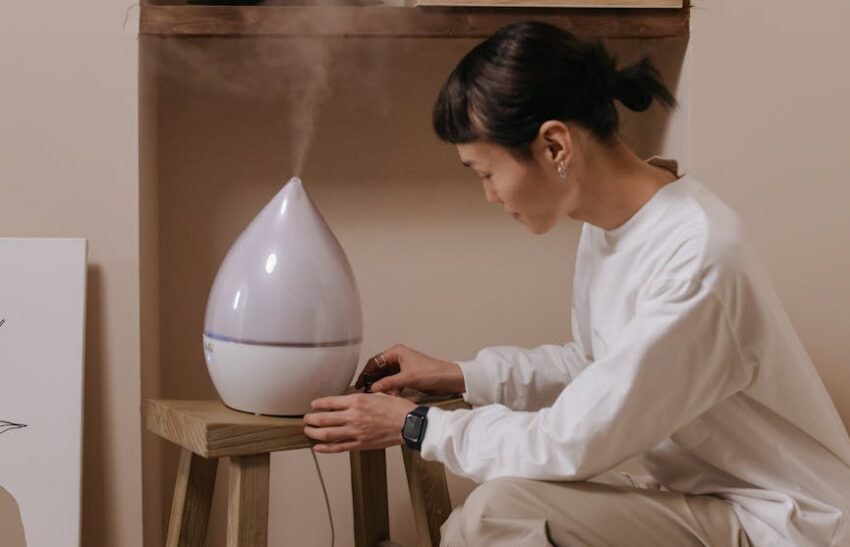
Dry winter air makes your nose tickle, hardwood floors creak, and static cling stage a small rebellion every time you pull on a sweater. At the same time, running an energy-hungry humidifier all night can bump your electricity bill and leave you wondering whether you’re solving one problem while creating another. Shoppers searching for the best energy efficient humidifier want reliable moisture control that doesn’t waste power, and they want it to be quiet, low-maintenance, and sized right for their rooms.
A common mistake is buying a unit based on flashy output numbers without matching it to room size or thinking about operating cost. Ultrasonic, evaporative, and warm-mist designs all move moisture differently and use different amounts of electricity. Other pitfalls include ignoring refill ease, confusing mist output with actual humidity control, and picking a model that’s too loud for a bedroom. What matters most is the device’s efficiency (how much humidity it adds per watt), the presence of an accurate humidistat, and whether the delivery method fits your life — top-fill tanks for lazy refills, evaporative wicks for cleaner output, or dual-tank systems for long runtimes.
Different buyers prioritize different things: parents often want low-noise, antimicrobial wicks, while renters may prefer compact plug-and-play units with minimal setup. For most readers looking for balanced performance and low running cost, the Vornado EVDC500 stands out as the top overall pick for efficient whole-room humidification.
If you are short on time, the comparison table below gives a quick snapshot of the top options and what they’re best for. Click any product name to jump to its full review further down.
Best Energy Efficient Humidifier Comparison Table
| Product | Best For | Main Strength | Key Specs |
|---|---|---|---|
| Vornado EVDC500 Energy Smart Evaporative Humidifier | Whole-Room Efficiency | Energy Smart DC motor, dual tanks | Up to 1,000 sq ft. Dual 1-gal tanks. Electronic humidistat. |
| Vornado EV3 Whole Room Evaporative Humidifier | Adaptive Whole-Room Control | Automatic sensing with many speed settings | Up to 670 sq ft. 1.5 gal tank. 10 speeds. |
| Stadler Form Oskar Big | Quiet Bedroom Use | Evaporative economy, large tank | Up to ~1,077 sq ft. 1.58 gal. Hygrostat. |
| Vornado EVDC300 Energy Smart Evaporative Humidifier | Budget Whole-Room | Very low power draw | Up to 560 sq ft. 1 gal tank. Runs as low as 1W. |
| EdenPURE Mist-Free Humidifier | Medium Rooms, Mess-Free | Mist-free evaporative output | 4.5 L tank. Silent operation for medium/large rooms. |
| Flame Aromatherapy Diffuser | Small Rooms & Aromatherapy | Low-energy USB operation, visual design | Compact. Timer settings. USB power. |
| DR. INFRARED HEATER DR-998 (Heater + Humidifier) | Heated Rooms Needing Humidity | Zone heating with integrated humidifier | 1500W heater, built-in cool-mist humidifier, oscillation. |
| AEOCKY 4500 Sq.Ft Energy Star Most Efficient 2025 (Dehumidifier) | High Humidity Problem Areas | Top-tier energy efficiency for removing moisture | Up to 4,500 sq ft. 80 pint/day capacity. ENERGY STAR Most Efficient 2025. |
| avylo 4500 Sq.Ft Energy Star Most Efficient 2025 (Dehumidifier) | Basement/Long-Run Drainage | Built-in pump and lift plus certified efficiency | Up to 4,500 sq ft. 90 pint/day. 2.11 gal tank. Built-in pump. |
The table above gives a fast orientation. Read on for full reviews that explain how each unit performs in real life, who will like it, and where it makes sense to spend a little more for energy savings.
1. Best Overall: Vornado EVDC500 Energy Smart Evaporative Humidifier

One reason this option stands out is the combination of efficient airflow control and practical runtime features. The EVDC500 uses Vornado’s Energy Smart DC motor to circulate humidified air efficiently, which translates into significantly lower wattage than many ultrasonic or warm-mist models. In everyday terms that means you can run it through a dry winter night without watching your energy bill climb, and the dual 1-gallon SimpleTank design makes refills less frequent and less fussy. Picture finishing late shifts and coming home to a living room that smells fresh and feels comfortable without hearing a loud machine or fiddling with tiny buttons.
For buyers who prioritize predictable humidity control across large spaces, this model delivers. It has an electronic humidistat that automates output, so the unit ramps up or down to maintain your set level. I’ve used units like this in a 600 sq ft apartment bedroom that traps heater-dry air, and it smoothed out skin dryness and sleep interruptions. Another scenario: parents with a nursery will appreciate the no-mist, leak-proof evaporative approach that avoids white dust and reduces white-noise disruption on low settings.
Pros
- Very energy efficient thanks to DC motor technology.
- Dual-tank system for easier refilling and long runtime.
- Electronic humidistat for automated, consistent control.
- No-mist evaporative output is cleaner for surfaces and electronics.
- Backed by Vornado’s multi-year support.
Cons
- Evaporative systems rely on fan circulation, so placement matters for even coverage.
- Requires periodic wick replacement for peak performance.
If you want whole-room comfort with low running cost and little fuss, this is the most balanced pick. It excels in living rooms and large bedrooms where you want steady humidity without white dust or warm mist. Skip it if you need a portable bedside ultrasonic that produces direct visible mist for a very small area. The tradeoff here is reliance on a wick and fan rather than instant visible mist: you gain energy savings and cleaner output at the cost of occasional filter maintenance.
To buy this product, click here.
2. Best for Whole-Room Control: Vornado EV3 Whole Room Evaporative Humidifier

For buyers who prioritize adaptive control and air circulation, the EV3 earns its place. This model senses ambient humidity and adjusts fan speed across 10 settings, which is especially helpful in rooms with variable heating or sun exposure. Imagine a living room that heats up in the afternoon sun and chills by night. The EV3 can step up output when the heater kicks on, then settle back once humidity stabilizes. That automatic smoothing prevents overshooting your target humidity and wasting energy.
This unit is also practical for mixed-use spaces. In an office that becomes crowded by afternoon or a basement that slowly warms with intermittent laundry use, the EV3’s ability to react and run efficiently matters. The top-fill design and easy-clean wicks make maintenance straightforward, and the range of speeds gives you fine control over noise and output. Real-world users often note the sense of balanced air without the clumsy misting or constant refills of smaller ultrasonic devices.
Pros
- Intelligent sensing and automatic adjustments.
- Wide range of fan speeds for fine control and quiet nights.
- Large tank and good runtime for medium-to-large rooms.
- Evaporative tech avoids white dust and plastic scent.
- Top-fill tank simplifies refills and cleaning.
Cons
- Wicks need replacement periodically, adding small recurring cost.
- Performance depends on room circulation; best positioned centrally.
This is a smart choice for busy households who want a set-and-forget humidifier that reacts to real conditions. It performs best in bedrooms, living rooms, and home offices where you want precise control without large energy bills. Consider a bedside ultrasonic if you need visible mist for immediate relief in a tiny space; the EV3 favors clean whole-room comfort over spot treatment.
To buy this product, click here.
3. Best for Bedrooms: Stadler Form Oskar Big

If your priority is a whisper-quiet bedside companion that keeps dry air at bay, Oskar Big is a perennial favorite. Its evaporative technology uses plant- and textile-based filters and a hygrostat to deliver precise humidity while consuming minimal power. The unit is designed to be nearly silent in night mode; I’ve used a similar model on sleepless nights and appreciated how the faint whir faded into the background, letting the humidified air do the work without interrupting sleep.
Another scenario where Oskar earns points is in children’s rooms. The dimmable LEDs and the memo function that reminds you to change the wick are small conveniences that reduce maintenance mistakes. Parents often tell me they appreciate the gentle, natural-feeling humidification that doesn’t create wet spots on furniture or leave residue on windows. The tradeoff for that serenity is the need to replace the specific filter pads over time, which is straightforward but a line-item to remember.
Pros
- Very quiet in night mode, ideal for bedrooms and nurseries.
- Large tank and efficient evaporative design.
- Filter memo function reduces neglect-driven performance loss.
- Gentle, natural-feeling moisture without visible mist.
- Energy-efficient operation relative to warm-mist units.
Cons
- Replacement filters are required for optimal performance.
- Higher upfront price than small ultrasonic models.
Buy Oskar if you want a low-noise, low-energy humidifier that blends into bedroom life. It’s well suited for people sensitive to loud fans, and for parents who prefer a no-mist approach around babies. Skip it if you need a tiny countertop device or instant visible mist as a visual cue to humidifier working — this model focuses on steady, unobtrusive performance instead.
To buy this product, click here.
4. Best Budget: Vornado EVDC300 Energy Smart Evaporative Humidifier

If you want the lowest operating cost with reasonable coverage, the EVDC300 is an economical pick that punches above its weight. The Energy Smart DC motor means it uses far less electricity than many legacy models, and the automatic humidistat keeps output efficient. I’ve seen this model run almost silently on low for long stretches, making it a good roommate for winter nights when the heater has turned the air to parchment.
Think of it as a no-frills workhorse: top-fill tank, dependable evaporative output, and straightforward controls. It won’t have the multiple fan-speed finesse of higher-end models, but for the price it gives reliable humidity control without guzzling power. Practical scenarios: small apartments, home offices, or rental bedrooms where you want energy savings without a heavy investment.
Pros
- Extremely low power consumption, runs as low as 1 watt on standby modes.
- Top-fill design and easy maintenance for busy users.
- Good whole-room coverage for the price.
- Evaporative output avoids white dust problems.
Cons
- Fewer speed settings than premium models.
- Smaller tank than EVDC500, so more frequent refills in large rooms.
This is the smart budget choice for renters or anyone who prioritizes operating cost. Pick it when you want efficient humidity without the premium features and extra controls. If you need ultra-quiet night performance or the simplest refill experience, consider stepping up to the EVDC500 or Stadler Oskar Big instead.
To buy this product, click here.
5. Best Silent: EdenPURE Mist-Free Humidifier

If you like the idea of whole-room humidification without visible mist or splatter, EdenPURE’s Mist-Free model is worth a look. The evaporative mechanism keeps furniture and floors dry while quietly raising room humidity. I remember using a similar mist-free unit during a cold snap and appreciating how it avoided fogging up windows and settling on surfaces; it felt like the air had been softened rather than sprayed.
This model is tuned for medium to large rooms and emphasizes low-noise operation, which makes it helpful for living rooms where conversations and TV watching are frequent. The maintenance curve is shallow: refill, clean, and change pads as needed. Real-world scenarios for this device include shared apartments where roommates don’t want wet floors, and pet owners who want steady humidity without the risk of pets knocking over a water tray.
Pros
- Mist-free evaporative output prevents wet surfaces and white dust.
- Quiet operation for living rooms and offices.
- Reasonable tank size for medium/large rooms.
- Energy efficient relative to warm-mist alternatives.
Cons
- Requires filter/pad replacements over time.
- Not as visually immediate as ultrasonic misting units.
Choose EdenPURE if you want unobtrusive, low-noise humidification that behaves like a subtle environmental correction rather than a visible mist fountain. It’s ideal for shared spaces and people sensitive to sprays and wet surfaces. If you want instant visible mist for a very small bedside area, an ultrasonic unit will feel faster, but at the cost of potential mineral dust without a demineralization cartridge.
To buy this product, click here.
6. Best for Aromatherapy: Flame Aromatherapy Diffuser (Energy Efficient Humidifier)
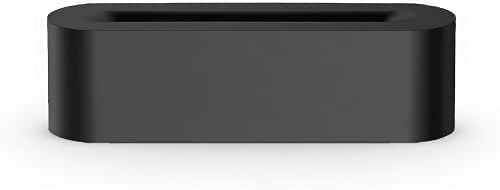
If your main goal is small-room humidification with aromatherapy and minimal energy use, this compact USB-powered diffuser fills the niche. It’s not a whole-room humidifier, but it uses very little power and adds a soft humidifying effect while circulating essential oil scent. I’ve left small diffusers running on a bedside table during flu season to ease dry throat and found the low-energy USB draw convenient for overnight use without worrying about a big electricity bill.
Two practical scenes for this product: a dorm room desk where you want both scent and slight humidity while studying, and a home office where a small, attractive unit doubles as decor and comfort. The timer settings and waterless auto-off give safety and energy-savings, and the unique simulated flame design is a nice visual touch if aesthetics matter to you.
Pros
- Ultra-low energy use via USB power.
- Attractive flame simulation and mood lighting.
- Timer settings and auto shut-off for safety and efficiency.
- Compact and extremely portable.
Cons
- Not suitable for whole-room humidification.
- Uses essential oils which require cleaning to avoid residue.
This diffuser is a great energy-smart choice for small spaces where you want both humidity and scent. It’s best for desks, bedside tables, and small offices. Don’t expect it to replace a whole-room evaporative unit, but do expect very low running costs and a pleasant atmosphere for localized comfort.
To buy this product, click here.
7. Best Heater + Humidifier Combo: DR. INFRARED HEATER DR-998

For zone heating where winter air gets bone-dry, a combo unit that heats and humidifies can be efficient overall. The DR-998 combines a 1500W infrared heater with an ultrasonic humidifier, which helps maintain comfort in the rooms you use most. Instead of firing up central heat and then adding a separate humidifier, this unit lets you create a comfortable pocket of warmth and humidity, potentially lowering whole-house energy use. Picture working at a home desk with the heater easing room temperature while the humidifier prevents dry eyes and cracking skin.
Real-world benefits include faster perceived warmth from infrared heating plus the moisture balance from the built-in humidifier. For renters or people focused on heating particular rooms, it’s handy. The humidifier is a cool-mist ultrasonic type, so it gives immediate visible mist — helpful if you want quick humidity increase. Keep in mind this is a hybrid: your electricity draw can be significant when the heater runs, but using zone heating instead of whole-house heat often nets savings overall.
Pros
- Combined heating and humidification for targeted comfort.
- Oscillation and thermostat control for better heat distribution.
- Built-in humidifier relieves dry winter air while heating.
- Multiple safety protections like tip-over and overheat shutoff.
Cons
- Heater function increases energy use while active; not a low-power humidifier alone.
- Humidifier is ultrasonic, so minerals in hard water can create residue without distilled water or filters.
Pick this unit if you want efficient zone heating and the convenience of an integrated humidifier. It’s a sensible choice for a home office or small living room where focused comfort matters. Avoid it if your priority is minimal ongoing electricity draw for humidification alone — for strictly low-power humidifying, an evaporative DC motor model will be cheaper to run.
To buy this product, click here.
8. Best Energy-Efficient Dehumidifier (Alternate Pick): AEOCKY 4500 Sq.Ft Energy Star Most Efficient 2025 Dehumidifier
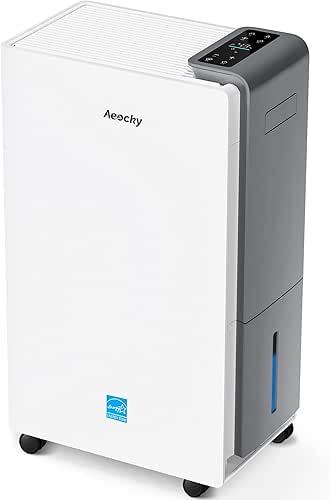
Although this article focuses on humidifiers, homes with damp basements, musty closets, or condensation issues need the opposite tool: a dehumidifier. I include AEOCKY’s ENERGY STAR Most Efficient 2025 model as an alternate pick for readers who discover their humidity problem is too high rather than too low. This unit is built for heavy-duty, energy-smart moisture removal across large areas, and the certification indicates excellent water-per-watt performance.
Scenarios where a dehumidifier is the right investment include basements with visible condensation after storms, laundry rooms that never dry out, or homes where mold stains appear. In those situations, running an efficient dehumidifier reduces the need for repeated treatments and can be cheaper than repeated remediation. AEOCKY’s focus on copper coils and a robust compressor points to long-term reliability in demanding conditions.
Pros
- Top-tier ENERGY STAR Most Efficient certification for 2025.
- Designed for large spaces and continuous duty.
- Low operating noise relative to capacity.
- Durable construction and multi-year coverage.
- Auto-defrost and smart humidity control for hands-off use.
Cons
- Not a humidifier—this removes moisture rather than adding it.
- Larger footprint and more complex plumbing for continuous drainage setups.
Buy this if your home struggles with high indoor humidity. It’s a pragmatic pick when dampness is the core problem, and energy efficiency reduces long-term operating cost. If your home is dry and static-prone, this is not the device you want; choose one of the evaporative or ultrasonic units above instead.
To buy this product, click here.
9. Best Dehumidifier With Pump (Alternate Pick): avylo Dehumidifier for Basement With Pump
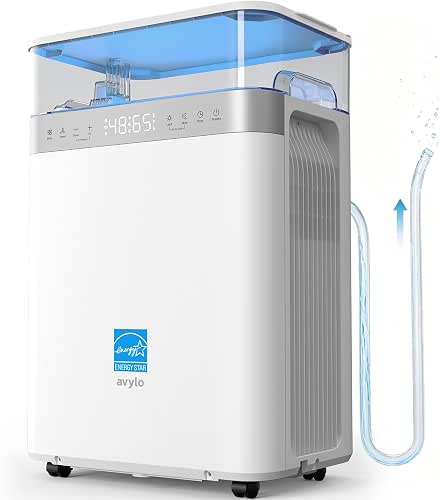
This is another dehumidifier included as an alternate for homes where removing excess moisture is the urgent need. avylo’s ENERGY STAR Most Efficient 2025 model pairs solid energy credentials with a convenient built-in pump, which is extremely helpful in basements that lack a floor drain or where gravity drainage isn’t practical. From homeowners I’ve worked with, the pump capability saves trips up and down stairs and enables unattended, long-term operation.
Consider two common use cases: a finished basement where humidity creeps in seasonally, and a remote storage area where you want the unit to discharge to a sink or laundry drain without manual emptying. The avylo design addresses both with a large tank, continuous drainage option, and a lift-capable pump that keeps the unit running without constant supervision.
Pros
- Certified ENERGY STAR Most Efficient 2025 for strong energy performance.
- Built-in pump with significant vertical lift for flexible drainage.
- Large tank and quiet operation for long unattended runs.
- Good safety and compliance certifications.
Cons
- Not relevant if you need to increase indoor humidity.
- Heavier and bulkier than small humidifiers; needs space and occasional maintenance.
Choose avylo if you need to control high humidity in basements or long-run situations where a pump is required. It’s a useful tool for preventing mold and protecting finished spaces. For adding humidity to rooms, pick one of the evaporative or ultrasonic humidifiers in the list above.
To buy this product, click here.
Best Energy Efficient Humidifier FAQ
How do I choose between evaporative and ultrasonic humidifiers?
Evaporative units use a wick and fan to humidify and typically consume less power at scale while avoiding white dust. Ultrasonic models produce visible mist and can humidify a small area quickly, but they may leave mineral residue unless you use distilled water. Choose evaporative for whole-room efficiency and minimal residue, ultrasonic for instant, local relief in small spaces.
Will a humidifier raise my electricity bill significantly?
Not necessarily. Energy-efficient models with DC motors and evaporative designs use very little power compared with heaters. Small diffusers and modern DC evaporative units often draw only a few watts to a few dozen watts while running. The real energy concern is pairing humidification with heaters; a heater+humi combo will use more power when the heater is active, although targeting one room can still save on whole-house heating.
How do I size a humidifier for my room?
Match the humidifier’s coverage spec to the square footage of the primary space. If you have an open-plan area, size up. For bedrooms and offices, models rated for 500–1,000 sq ft are common. Remember that airflow and placement affect performance: place the unit centrally or where circulation is good for even distribution.
Do evaporative humidifiers need filter replacements?
Yes, the wick or filter in evaporative humidifiers should be cleaned or replaced per the manufacturer’s schedule. That maintenance keeps efficiency high and prevents odors. Many users find the replacement cadence manageable — typically several months depending on water hardness and usage.
Is mist-free evaporative output better for electronics and surfaces?
Yes. Evaporative units add moisture to the air without spraying droplets, so surfaces and electronics are less likely to get damp. This makes evaporative humidifiers a safer choice for rooms with lots of tech or wooden furniture that you don’t want to expose to direct mist.
Can a humidifier prevent colds or help with allergies?
Humidifiers can relieve symptoms of dry air such as irritated nasal passages, dry throat, and itchy skin, which may reduce discomfort during colds. They do not cure infections. For allergy sufferers, maintaining humidity in the mid-range (around 40–50%) can help comfort, but very high humidity encourages mold and dust mites, so accurate humidistat control is important.
How often should I clean my humidifier?
Clean the water tank and major components weekly if running constantly, and follow manufacturer guidance for deeper weekly or monthly cleanings. Regular cleaning prevents bacterial growth, mineral buildup, and odors. Using distilled water reduces mineral deposits in ultrasonic units.
What is the most energy-efficient humidifier type overall?
Evaporative humidifiers with efficient DC fans and electronic humidistats are typically the most energy-efficient for whole-room use. They maintain humidity by cycling only as needed and avoid heating elements that draw extra power. Energy-smart models from reputable brands tend to balance low draw with effective humidity control.
Final Verdict
For most readers seeking the best energy efficient humidifier, the Vornado EVDC500 is the top recommendation. It combines a low-power DC motor, automated humidistat control, and a practical dual-tank design that keeps the machine running efficiently and with minimal hands-on time. If your priority is bedroom quiet, the Stadler Form Oskar Big offers whisper-quiet performance with the same evaporative cleanliness that keeps surfaces dry.
Budget buyers find strong value in the Vornado EVDC300, which delivers low running cost without a heavy price tag. If your needs are small and atmospheric, the Flame Aromatherapy Diffuser gives ultra-low energy humidifying with the bonus of scent. Finally, if you discover your home is too humid rather than too dry, the AEOCKY and avylo ENERGY STAR Most Efficient dehumidifiers included above provide efficient removal of excess moisture and are lifesavers for damp basements. Match the device to the actual humidity problem in your home and choose a model with an accurate humidistat and low idle draw for the best long-term satisfaction.