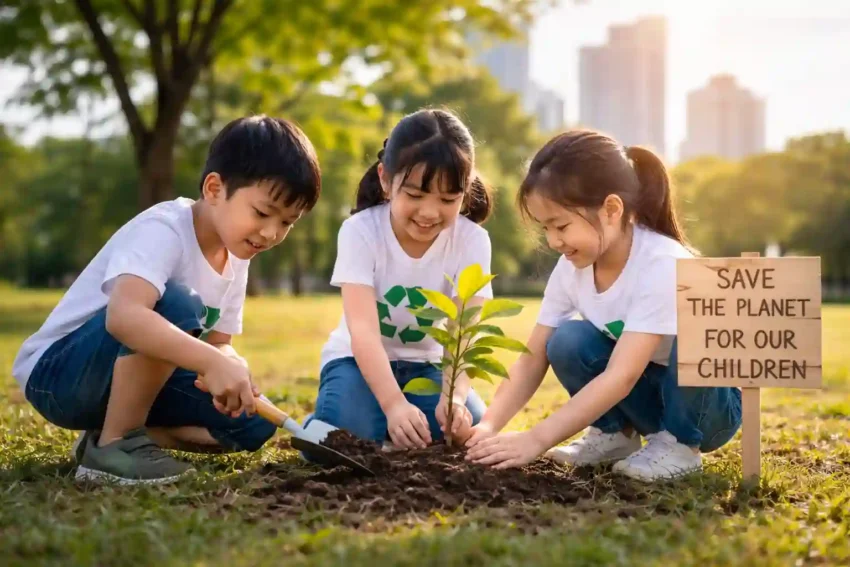
A world without pollution for children may sound idealistic, but it often begins with small, practical changes at home. When people think of gifts for Children’s Day, toys, gadgets, and colorful packaging often come to mind. These are easy choices, and for a moment, they bring excitement. But if we take a step back, a more meaningful question quietly emerges: what kind of world are we preparing for the children who receive these gifts?
In recent years, more parents have started to rethink what a “gift” truly means. Instead of focusing only on short-term happiness, there is growing awareness that the environment children grow up in may matter far more than anything wrapped in a box. Clean air, safe water, and a stable climate are not abstract ideas. They directly shape a child’s health, development, and future opportunities.
A world without pollution may sound idealistic, even unrealistic. But in practice, it begins with small, consistent choices made at home. And in that sense, it may be one of the most meaningful gifts we can offer.
Why Pollution Matters More for Children Than We Think
Children are not simply “small adults.” Their bodies are still developing, which makes them more vulnerable to environmental risks.
Air pollution, for example, has been linked to respiratory issues such as asthma, reduced lung function, and even long-term cognitive effects. Unlike adults, children breathe more rapidly relative to their body size, meaning they absorb more pollutants in the same environment.
Water and food contamination also carry higher risks. Exposure to microplastics, pesticides, and heavy metals during early development can have lasting consequences that may not become visible until years later.
Even everyday surroundings play a role. Indoor air quality, household materials, and the products we use daily all contribute to a child’s overall exposure. In many cases, the issue is not a single major hazard, but a continuous accumulation of small environmental stressors.
Understanding this shifts the perspective. Pollution is no longer a distant global issue. It becomes something immediate, personal, and closely tied to family life.
What Does a “World Without Pollution” Really Mean?
It is easy to imagine a perfect, untouched natural world, but in reality, reducing pollution is about making environments safer and more sustainable, not achieving absolute perfection.
A cleaner world for children includes several practical dimensions.
First, it means improving air quality, both outdoors and indoors. This involves reducing emissions, but also paying attention to ventilation, dust, and household chemicals.
Second, it involves minimizing unnecessary waste, especially plastic. Children today grow up surrounded by disposable products, many of which are used only once and then discarded.
Third, it includes safer consumption patterns. This applies to food, clothing, toys, and everyday products. Choosing items that are durable, low in harmful substances, and responsibly produced can significantly reduce long-term exposure.
Finally, it is about building habits. A pollution-free world is not only created through technology or policy, but through daily routines that shape how children interact with their environment.
Practical Ways to Reduce Pollution at Home
Creating a healthier environment does not require drastic lifestyle changes. In many cases, small adjustments can make a meaningful difference over time.
One of the simplest starting points is reducing single-use plastic. Replacing disposable items with reusable alternatives, such as water bottles, lunch containers, and shopping bags, immediately lowers waste output.
Energy use is another area worth examining. Choosing energy-efficient lighting, turning off unused devices, and optimizing heating or cooling can reduce both environmental impact and household costs. These changes are often subtle, but they accumulate.
Household products also deserve attention. Cleaning agents, air fresheners, and even some personal care products can introduce unnecessary chemicals into the living space. Opting for simpler, lower-impact alternatives can improve indoor air quality.
Involving children in these choices can be especially powerful. When they understand why certain decisions are made, they are more likely to adopt these habits naturally, rather than seeing them as restrictions.
Simple Eco-Friendly Gift Ideas for Children’s Day
If we rethink the idea of a gift, Children’s Day becomes an opportunity to introduce items and experiences that align with a healthier lifestyle.
Reusable products are a practical starting point. High-quality water bottles, lunch boxes, or backpacks designed for long-term use can replace disposable alternatives while still feeling like meaningful gifts.

Educational items can also play a role. Books about nature, science kits, or simple gardening tools can encourage curiosity about the environment. These are not just objects, but tools for exploration.
Experiences may be even more valuable. A day spent outdoors, visiting a park, hiking, or simply exploring local nature can leave a stronger impression than most physical gifts. These experiences help children build a direct connection with the environment they are learning to protect.
Even toys can be reconsidered. Choosing durable, well-made items instead of short-lived, trend-driven products reduces waste and often provides a better long-term experience.
The goal is not to eliminate enjoyment, but to align it with sustainability.
Teaching Children Environmental Awareness in Everyday Life
Children learn less from instructions and more from observation. The habits they see at home often become their own.
Simple actions, such as sorting waste, conserving water, or choosing not to overconsume, can gradually shape their understanding of responsibility. These actions do not need to be framed as strict rules. Instead, they can be presented as natural parts of daily life.
Conversations also matter. Explaining why certain choices are made, in a way that is appropriate for their age, helps children connect actions with outcomes. Over time, this builds a sense of awareness rather than passive compliance.
Importantly, the focus should not be on fear or guilt. Environmental awareness is more effective when it is associated with care, curiosity, and a sense of contribution.
A Different Way to Think About Gifts
The idea of giving children a better world may seem abstract compared to the simplicity of buying a toy. But in reality, it is built from concrete actions.
Every small decision, from reducing waste to choosing better products, contributes to the environment children grow up in. These choices may not provide instant excitement, but they create long-term value that extends far beyond a single day.
Children’s Day, then, becomes more than a celebration. It becomes a reminder that the most meaningful gifts are often not the ones we give directly, but the conditions we help create.
A cleaner, healthier world is not achieved overnight. It is the result of consistent, thoughtful choices. And in that sense, it may be the most lasting gift we can offer.