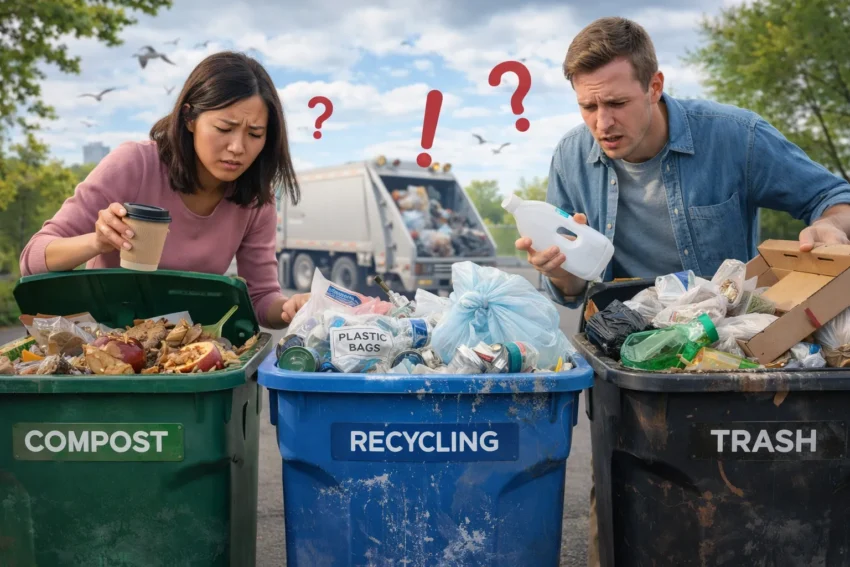
Every week, countless households around the world carefully sort their waste into recycling bins, compost containers, and garbage cans. We rinse out bottles, flatten cardboard boxes, and pause for a moment to decide where a used coffee cup should go. These small actions carry a sense of responsibility—and often, quiet pride.
Yet the uncomfortable reality is that much of this carefully sorted waste never becomes what we hope it will. Large portions still end up in landfills or incinerators, while some escape into rivers, oceans, and soil. Globally, cities generate billions of tonnes of household waste each year, and a significant share of it is still handled in environmentally harmful ways. Plastic offers the clearest example: despite decades of recycling campaigns, only a small fraction of plastic waste is ever truly recycled. Most is buried, burned, or lost to the natural environment.
This disconnect between intention and outcome raises a difficult but important question:
Why does waste sorting fail so often—even when people are genuinely trying their best?
The answer is not simple. Waste sorting fails not because people are careless or indifferent, but because the system surrounding them is fragmented, confusing, and often poorly aligned with how modern waste is produced and managed. Human behavior, infrastructure design, policy choices, economic incentives, and material limitations all interact in ways that quietly undermine even the most well-meaning efforts.
This article examines the root causes of residential waste sorting failures across the world. Rather than placing blame on individuals, it focuses on the deeper structural reasons why good intentions so often fail to translate into meaningful environmental outcomes.
Behavioral Challenges: Confusion, Convenience, and Misconceptions
One of the most immediate barriers to effective waste sorting lies in everyday human behavior—not because people lack concern, but because sorting waste requires constant attention, judgment, and effort in environments that are rarely designed to support it. Even individuals who care deeply about environmental issues often struggle to sort waste correctly and consistently, not due to apathy, but due to cognitive overload, habit friction, and unclear signals from the system itself.
Confusion Over What Belongs Where
Modern packaging has become increasingly complex, often combining multiple materials into a single item. A food container may appear to be plastic, but include thin metal layers, chemical coatings, or bonded adhesives. Recycling symbols add to the confusion rather than resolving it: they look official and reassuring, yet rarely indicate whether an item is actually recyclable within a specific local system.
What makes this worse is the lack of consistency across regions. An item accepted in one city may be rejected in another due to differences in processing facilities. For residents who move, travel, or consume nationally distributed products, this inconsistency creates constant uncertainty. Faced with ambiguity, many people resort to “wish-cycling”—placing questionable items in the recycling bin in the hope that they can be recycled.
Paradoxically, this well-intentioned behavior often causes more harm than good. Non-recyclable items contaminate recycling streams, lowering material quality and increasing rejection rates. Over time, repeated uncertainty erodes confidence. When people feel they are guessing rather than acting with clarity, participation becomes fragile and easily abandoned.
Convenience Often Wins
Waste sorting does not happen in a vacuum—it competes with time pressure, fatigue, and daily routines. Even environmentally conscious individuals prioritize convenience when sorting becomes inconvenient or disruptive. Rinsing containers, separating materials, storing multiple bins, or carrying waste to distant collection points all add friction.
When the effort required to sort waste feels disproportionate to the perceived benefit, people default to the simplest option: throwing everything into one container. This is not a moral failure but a predictable human response. Behavior consistently follows the path of least resistance, especially in repetitive, low-reward tasks.
Systems that rely on constant self-discipline rather than intuitive design inevitably see declining accuracy over time. When recycling is easy, visible, and seamlessly integrated into daily life, people comply naturally. When it feels like extra work layered onto already busy lives, even strong environmental values struggle to compete.
Lack of Feedback and Learning
Another major behavioral barrier is the absence of feedback. Most households never find out whether they are sorting correctly. Mistakes are invisible and consequences delayed. Recycling collectors do not provide corrections, and contamination is detected only once materials reach processing facilities—far removed from the original decision point.
Without feedback, incorrect habits persist indefinitely. People may believe they are recycling responsibly while unknowingly contributing to contamination. This creates a false sense of success, where effort feels validated but outcomes quietly fail.
In learning terms, waste sorting is a system with no feedback loop. There is no mechanism for gradual improvement, no reinforcement of correct behavior, and no correction of repeated errors. Over time, this disconnect weakens both accuracy and motivation.
Skepticism and Psychological Distance
As people become aware of recycling failures—through news reports, personal anecdotes, or local controversies—skepticism sets in. Stories of recyclables being dumped or burned undermine trust in the system. When individuals believe their efforts are nullified downstream, motivation declines sharply.
This psychological distance matters. Sorting waste begins to feel symbolic rather than effective, a ritual performed out of obligation rather than conviction. Responsibility feels misplaced when corporations continue producing unrecyclable packaging and governments fail to invest in infrastructure.
In this context, disengagement is not irrational. It reflects a growing awareness that personal effort alone cannot compensate for systemic shortcomings.
Systemic Flaws in Waste Management Systems
Even if every household sorted waste perfectly, outcomes would still depend on what happens after collection. In many regions, the systems designed to handle sorted waste are fragmented, underfunded, or poorly aligned with real-world behavior. These systemic flaws quietly undermine individual effort, turning good intentions into disappointing results.
Fragmented and Inconsistent Rules
Recycling systems are highly localized. What counts as recyclable varies not just by country, but by city or even neighborhood. This fragmentation makes it nearly impossible to provide clear, universal guidance to the public.
As a result, consumers are often blamed for mistakes that originate in system design. Packaging is standardized at national or global scales, while recycling rules are local and variable. This mismatch places an unreasonable cognitive burden on households, asking them to adapt constantly to invisible infrastructure differences.
Single-Stream Recycling and Contamination
Single-stream recycling was introduced to increase participation by simplifying behavior. While it succeeded in raising collection rates, it also increased contamination. When paper, plastics, glass, and metals are mixed together, fragile materials break, food residue spreads, and non-recyclables slip in unnoticed.
As contamination rises, the economic value of recyclables falls. Processing becomes slower, more expensive, and less reliable. In severe cases, entire loads are rejected and diverted to disposal. From the household’s perspective, everything looked correct; from the system’s perspective, the material is unusable.
This design trade-off highlights a central tension: systems optimized for convenience at the front end often struggle at the back end.
Limited Processing Capacity
In many regions, recycling infrastructure has failed to keep pace with waste generation. Some materials are collected without any local facility capable of processing them. Rural areas face high transportation costs, while many developing regions lack even basic waste treatment systems.
Globally, millions of people have no access to formal waste collection at all. In these contexts, sorting at home—no matter how well intentioned—has little practical impact. Waste ends up burned, dumped, or unmanaged, regardless of individual behavior.
All-or-Nothing Outcomes
Many recycling systems operate on rigid thresholds. If contamination exceeds acceptable levels, materials are rejected entirely. This creates a fragile system where a small number of errors can negate the efforts of many households.
Because errors are rarely traced back to their source, responsibility is diffused. Residents experience collective failure without clear explanation, leading to frustration and declining trust. Over time, this erodes participation and reinforces the perception that sorting “doesn’t really work.”
Policy and Economic Forces That Undermine Sorting
Behind the visible systems of bins, trucks, and sorting facilities lie powerful policy decisions and economic forces that quietly determine whether waste sorting succeeds or fails. While households interact only with the front end of the system, the fate of sorted waste is ultimately shaped by regulations, market incentives, and financial priorities that most people never see. In many cases, these upstream forces actively undermine even the most careful sorting efforts, making failure not an exception, but a structural outcome.
Packaging Without Responsibility
One of the most fundamental policy failures in waste management is the lack of responsibility placed on producers for the waste their products create. In many countries, once a product is sold, the manufacturer bears no obligation for what happens to its packaging after disposal. The cost of collecting, sorting, and processing waste is instead pushed onto municipalities and taxpayers.
This arrangement strongly incentivizes packaging designs that prioritize low cost, durability, and visual appeal over recyclability. Multi-layer plastics, composite materials, glossy coatings, and black-colored plastics dominate supermarket shelves precisely because they are cheap and functional—not because they can be recovered after use. From the consumer’s perspective, this creates an impossible task: no amount of careful sorting can make fundamentally unrecyclable materials recyclable. When people are told to “recycle more” without changes at the design stage, they are being asked to compensate for decisions made far upstream in the supply chain.
Over time, this mismatch breeds frustration. Consumers sense that the system is unfair, and rightly so. Sorting waste becomes an exercise in damage control rather than a meaningful solution.
Weak or Inconsistent Mandates
Policy strength varies dramatically across regions, and the difference shows clearly in outcomes. Where recycling and composting are mandatory, well-funded, and standardized, waste diversion rates tend to be significantly higher. Where participation is voluntary, loosely regulated, or inconsistently enforced, progress is slow and uneven.
In many jurisdictions, recycling exists as a recommendation rather than a requirement. Local governments may offer bins and educational materials, but without binding targets or penalties, participation remains optional and investment limited. Infrastructure upgrades are postponed, public education is underfunded, and sorting rules change frequently as budgets fluctuate.
This inconsistency creates confusion for residents and weakens trust in the system. When rules change without explanation, or when neighboring cities operate entirely different programs, people struggle to keep up. Over time, sorting begins to feel arbitrary rather than purposeful.
Recycling Often Costs More Than Disposal
Economic reality is one of the most powerful forces working against effective recycling. In many regions, it is still cheaper to landfill or incinerate waste than to recycle it properly. Virgin materials—especially plastics made from fossil fuels—are often less expensive than recycled alternatives, particularly when environmental costs are not reflected in prices.
This imbalance means that even when waste is collected and sorted, recycling may not be financially viable. If markets for recycled materials collapse or transport costs rise, municipalities are left with few options. Sorted waste may be quietly redirected to disposal facilities, often without public disclosure.
From the outside, recycling appears to be happening. Bins are collected, trucks run on schedule, and residents continue sorting. But behind the scenes, economics—not environmental intent—determines the final outcome.
The Fragility of Global Recycling Markets
For years, many high-income countries relied on exporting large volumes of sorted recyclables to other parts of the world. This practice created the appearance of a functioning recycling system while masking deep structural weaknesses at home.
When overseas markets tightened restrictions or closed entirely, the system quickly unraveled. Materials that had been carefully sorted suddenly had nowhere to go. Storage yards filled, processing facilities reached capacity, and municipalities were forced to make uncomfortable choices. The episode revealed how dependent recycling had become on global trade rather than local resilience.
This fragility highlights a deeper issue: waste sorting systems are only as strong as the markets that support them. Without stable, local end uses for recycled materials, sorting becomes performative rather than effective.
Technological and Material Limits
Even under ideal conditions—clear rules, strong policy, and public participation—recycling still faces unavoidable physical limits. Technology cannot fully overcome the way materials are designed, used, and discarded. Understanding these limits helps explain why recycling rates remain stubbornly low despite widespread sorting efforts.
Not Everything Is Recyclable
Many products were never intended to be recycled. Thin plastic films, composite packaging, heavily soiled materials, and certain types of plastic simply cannot be processed economically with existing systems. Sorting these items correctly does not change their fundamental properties.
This reality often clashes with public expectations. Recycling symbols and environmental messaging create the impression that most waste can be recovered if sorted properly. In practice, a large portion of household waste has no viable recycling pathway, regardless of effort.
Technology Has Limits
Modern recycling facilities rely on sophisticated machinery, including optical sensors, magnets, air classifiers, and automated sorting systems. While impressive, these technologies are far from perfect. Small items fall through gaps, dark materials evade detection, and contamination interferes with sorting accuracy.
Food residue, moisture, and mixed materials remain persistent challenges. Technology can assist sorting, but it cannot fully correct errors introduced at the household level. Once waste streams are heavily mixed or contaminated, recovery rates drop sharply.
Recycling Is Often Downcycling
Even when materials are successfully recycled, the process is rarely infinite. Paper fibers weaken with each cycle, plastics lose structural integrity, and many recycled products cannot themselves be recycled again. As a result, recycling often delays disposal rather than eliminating it.
This does not make recycling meaningless—but it does mean that recycling alone cannot solve the waste problem. Without reductions in overall material use and improvements in product design, recycling becomes a temporary holding pattern rather than a closed loop.
Infrastructure Gaps and the Global Waste Divide
Across large parts of the world, the primary challenge is not inefficient recycling but the absence of basic waste management infrastructure. In these regions, household waste is frequently burned, dumped, or left uncollected, leading to severe environmental and health impacts.
Where formal systems are lacking, informal waste pickers often step in, recovering valuable materials under dangerous conditions. Their work highlights both the potential for resource recovery and the profound inequities embedded in the global waste system.
Without sustained investment in collection, processing, and safe disposal, waste sorting remains inaccessible to millions. The global waste crisis is therefore not just a technical problem, but a developmental one—reflecting deep disparities in infrastructure, funding, and political priority.
Conclusion: Why Good Intentions Are Not Enough
Waste sorting fails not because people are indifferent, careless, or unwilling to act, but because they are operating inside systems that were never designed to succeed at scale. Confusing rules, fragmented infrastructure, weak or inconsistent policies, volatile recycling markets, and the physical limits of materials all work quietly—and often invisibly—against individual effort. In such an environment, even the most diligent household can do everything “right” and still produce little meaningful impact.
This is an uncomfortable truth, especially for people who genuinely want to live more responsibly. For decades, environmental messaging has emphasized personal action: sort better, recycle more, be more careful. While individual behavior does matter, this framing has also created a subtle but harmful illusion—that environmental failure is primarily a matter of personal discipline. When recycling systems break down, the burden of guilt often falls on individuals, rather than on the structures that made failure likely in the first place.
The solution, therefore, does not lie in asking people to try harder or feel more responsible. It lies in redesigning the systems that surround them. When waste sorting is clear, convenient, and backed by reliable infrastructure; when products are designed with their end-of-life in mind; when recycling markets are stable and transparent; and when policies align economic incentives with environmental outcomes, individual effort suddenly becomes powerful rather than symbolic.
Where waste sorting succeeds, it is not because people are more virtuous, but because behavior, policy, technology, and economics are working in the same direction. The gap between effort and outcome narrows not through moral pressure, but through systemic alignment. Until that alignment exists, frustration and skepticism will continue to grow, and well-intentioned actions will feel increasingly hollow.
Understanding this reality is not a reason to disengage. On the contrary, it offers a clearer and more honest way forward. It shifts the conversation away from personal guilt and toward collective responsibility, institutional accountability, and structural change. When systems are built to support good behavior rather than fight against it, individual choices finally begin to matter in the way people were promised they would.
Only by fixing the system around individuals—not blaming the individuals within it—can our best intentions translate into lasting environmental progress.